
This post was last updated on September 7, 2026
An Exploratory Essay on the Star of Bethlehem—With reference to the Descriptions in Chapter Two of the Gospel According to Matthew
Daniel Hung Fai CHO and Helsa CHO, 2025
Revised and expanded from the essay for the course requirement of The Stars and Our Lives at The Chinese University of Hong Kong, 2023
Abstract
This essay presents an interpretation of the Star of Bethlehem, i.e., the Star, with reference to and synthesized from Frederick Larson’s and Dag Kihlman’s research, respectively. It explains the biblical relationship between kings and the stars, as well as the ancient Babylonian astrology that relates to the Star. Adopting the view that King Herod the Great died in 1 BC, it is estimated that on February 16, 2 BC, Jupiter was conjunct Regulus (the brightest star in the constellation Leo in the sky). Then on June 17, Jupiter was conjunct with Venus in the sky below the constellation Leo. These are probably the appearance of the Star pointing to the new Jewish King, as stated in Matthew chapter 2, verses 1 to 11 of the New Testament, as possibly understood by the wise men of the east. Eventually, with the guidance of Jupiter, they succeeded in finding the little child Jesus a few months later, on approximately December 25 of the same year, and worshipping him with gifts.
- 1. Introduction
- 2. Explore the three premises of the explanation of the Star of Bethlehem
- 3. The movements of Jupiter, Regulus, and Venus in 3 to 2 BC, and a possible understanding by the Wise Men
- 4. Some astrological significance of the Star of Bethlehem and the worship of the wise men from the east
- 5. Several other theories about the Star of Bethlehem
- 6. Conclusion
- Reference
1. Introduction
The Star of Bethlehem, i.e., the Star, recorded in Matthew 2:1-11 (chapter two, verses one to eleven, and so on) of the New Testament, guided several wise men from the east, or magi, to worship the little child Jesus. This is regarded as a single event, both in astrology and in the study of the New Testament. As a result, there is not much discussion about its meaning. But for Christians, the appearance of the Star is a confirmation of the reality of Jesus’ birth, especially for the discussion in the nineteenth and twentieth centuries of whether Jesus Christ really appeared in history (Schweitzer, 1905; Schweitzer, 2005). On the other hand, anyone who believes that the historical Jesus never appeared, or that the Gospel of Matthew in the New Testament is not a true historical record, will find it difficult to agree with the main arguments in this essay. Some people believe that there is a gap between the historical Jesus and the Christian faith. Even if the historical Jesus did appear, it would not have been the eternal and immortal Christ that numerous Christians believe in at a later time. However, if the Star had really appeared and pointed to Jesus, who was born during that time, this question might have been answered in a certain way. As mentioned below, in Babylon or Rome of the New Testament period, Jupiter was considered the principal planet and was thus regarded as representing the kingship of the greatest God (Kihlman, 2018, p. 91; Larson, 2017a). At one time, if there was a conjunction between Jupiter and Venus, it indicated that God had chosen to bestow a newborn King to represent Him and His kingship on earth (Kihlman, 2018, pp. 27, 91). In other words, the eternal and immortal Christ, as denoted in the Star of Bethlehem in Matthew 2, might have foreshadowed that Jesus was not just a historical figure or a great teacher. It is because the text implies that He is the King appointed by God to rule over His kingdom on earth.
The premises of this essay are, first, that Jesus was indeed a historical figure; second, the events described in Matthew 2:1-11 are true and reliable historical records. In other words, those wise men from the east were real people, and they were really looking for the newborn King of the Jews. The purpose of this study is to find out, as far as possible, what the Star of Bethlehem referred to in the above passage with reference to related astrologies. If that star appeared, how could it lead the wise men to accuracy in finding the little child Jesus? In other words, the main method of this article is to examine the content of the Bible and then screen out relevant information to support it. The authors have noted the shortcomings of this approach, including but not limited to the use of coincidental but unrelated information, which might misinterpret the text with biases and express a close relationship with various texts. So, we have researched quite a lot to make the details of this article as close as possible to historical facts with reliable evidence.
It is worth noting that since the beginning of the 21st century, due to technological advancements, including the use of computer simulation in astronomy has made it possible to retrace astronomical phenomena in the past, including celestial data around the time of Jesus’ birth. In other words, we can now navigate the starry sky at different places with various time frames through recent technology. This allows the astronomical signs after Jesus’ birth to reappear before readers after 2,000 years. Thus, the aforementioned research bias can largely be resolved with the help of astronomical technology.
The approach of this article is firstly to lay out the possible years of Jesus’ birth, as the suggested date of Jesus’ birth would rule out some possibilities of certain theories about the Star of Bethlehem. Then, we will discuss the relationship between kings and astrology from various passages in the Bible and speculate on the astrological knowledge or implicit biblical astrology that the magi of their time might have so as to understand how people at that time could perceive the relationship between celestial phenomena and the succession of kings on earth. Furthermore, we then explain Babylonian astrology in the New Testament times and before, and we believe that this background information might have been known to the magi in Matthew 2. This article simulates the wise men who, after getting the background information needed, studied the stars and eventually found and worshipped the little child Jesus, who was about one-and-a-half years old at the time in Bethlehem, according to the orbit of Jupiter. We carefully list the relative motions of Jupiter, Regulus, and Venus in 2 to 3 BC, and astrology corresponds to the phenomenal explanations of the Star in Matthew 2 in the following sections.
The magi might have understood the possible interpretation of Enuma Anu Enlil (the ancient Babylonian astrological clay tablets) concerning the Star of Bethlehem and related scriptures. When those interpretations of the stars were presented to Herod and the priests during that time, how did Herod and His companions and the wise men react differently to the appearance of the Star? This section would carefully describe how the heavenly stars move in conjunction, matching the scriptural descriptions of the magi going to Bethlehem to worship the little child Jesus. In the process, we presented some coincidental events, such as the relevant data of Babylonian astrology, which probably caused panic in the heart of Herod and his subjects, and the trajectory of Jupiter, which made several wise men feel that the Star “stopped” in the sky over the town of Bethlehem, and so on. If readers accept that this series of astrological signs coincides with the scriptural descriptions, you can conclude that the appearance of the Star in 2 BC did indeed guide the magi to worship the little child Jesus from the northeastern area to Israel.
Near the end of this article, we will briefly mention several possible suggestions or theories in relation to the Star of Bethlehem, including the emergence of comets, supernova explosions, etc., and why those suggestions do not conform to the claims explained in this article with reference to Matthew 2. Finally, we briefly pointed out that the magi who went far to worship Jesus through the guidance of the Star are worthy of imitation by Christians in our actions of worshipping Jesus.
2. Explore the three premises of the explanation of the Star of Bethlehem
From the perspective of astrology, there are several theories or suggestions to explain the appearance of the Star. Scholars have not yet commonly agreed on the year of Jesus’ birth in the study of the New Testament at the time of our writing. Although the year of Jesus’ birth is somewhat certain, most biblical scholars might lack interest in studying the movements of the celestial stars. Thus, the relevant information provided by them is relatively little and uncertain (Pickering 1986, p. 1122). As a result, there are many opinions about what the Star truly is. But we are quite interested in this Star, for among numerous stars in the sky, the Star of a newborn Jewish King could be found, and those who found it can indeed be called wise men. Their wisdom is worth admiring. Out of admiration for the magi and astronomical interest, we propose our understanding of the astronomical phenomena concerning Jesus’ birth, both from a biblical perspective and ancient Babylonian astrology, and especially providing explanations for two questions. First, what exactly is the Star of Bethlehem? And second, how could those wise men see the Star in the sky and then successfully find the little child Jesus at that time?
Before discussing our suggested understanding of the Star of Bethlehem, three premises will be explored: the approximate year of Jesus’ birth, biblical astrology, and Babylonian astrology in and before the New Testament period. We believe that the latter two are likely to be essential background information known to those wise men. This article begins with a discussion on the biblical source, because the most widely known source of the Star of Bethlehem is a biblical record.
2.1 The approximate year of Jesus’ birth
It is necessary to confirm the approximate year of Jesus’ birth to narrow the scope of the study and thus determine the possibility of the Star of Bethlehem with related astronomical phenomena during that time, e.g., whether there were related comets or planetary conjunctions. In this way, the Star at that time could be reliably inferred. So, let’s look at the year of Jesus’ death and extrapolate the year He might have been born. Helen Bond states that Jesus died between AD 29 and 34 (Bond, 2013). Some scholars believe that Jesus died in April, AD 30 (Elwell & Yarbrough, 2006, Chinese edition, p. 466). In addition, summarizing the following passages allows us to understand the year of Jesus’ birth. (Unless otherwise specified, the following scriptures are quoted from the New American Standard Bible, 1995.)
- “When He began His ministry, Jesus Himself was about thirty years of age.” (Luke 3:23a)
- “The Passover of the Jews was near, and Jesus went up to Jerusalem.” (John 2:13)
- “Now the Passover, the feast of the Jews, was near.” (John 6:4)
- “Now before the Feast of the Passover, Jesus knowing that His hour had come that He would depart out of this world to the Father.” (John 13:1a)
From the above passages, we can see that Jesus began his ministry at the age of about 30, and then he went through three Passovers before being crucified. That means he died at about 33 years old, i.e., the time of Jesus’ birth can be extrapolated from 4 BC to AD 1, possibly including 3 BC.
Some Bible scholars believe that the timing of the death of the Judean King Herod the Great is an important clue to suggest the date of Jesus’ birth, as Jesus was born during the reign of Herod. Some scholars believe that Herod died in 4 BC (Pickering, 1986, p. 1123). However, recent scholars who have studied the history of Judea written by Flavius Josephus (AD 37-100, Jewish historian) in the first century have suggested that the year of Herod’s death should be 1 BC (Jachowski, 2015). A. Steinmann also pointed out that Herod reigned from 39 to 1 BC (Steinmann, 2009). The conclusion of their studies that Herod died within a later time frame is more approximate to the investigation presented in this paper. Thus, the time of Jesus’ birth can be extrapolated to between 4 and 1 BC. Besides, this article is not about finding out the exact date of Jesus’ birth, but we will only take a closer look at some of the relevant astronomical signs that might have appeared between 4 and 1 BC. Based on the year Jesus was born, we ruled out some speculations or explanations of the Star, which will be briefly mentioned later in this article before the conclusion. If, on the other hand, the date speculated here for Jesus’ birth is wrong, several theories about the Star should be carefully re-examined.
2.2 Astrology in Ancient Israel
The ancient Hebrews of the Old Testament and the Jews of the New Testament are collectively referred to as ancient Israelites in this essay. The question of how the Bible views the stars is often ignored by astrologers because, although there are about 70 verses concerning “star” or “stars” in the Bible, the passages on the relationship between stars and human beings account for only one-tenth of them. There are two main opinions in the public about how the Bible views the stars in the sky. First, it points out that the Bible opposes the practice of general horoscopes, i.e., general astrology, to speculate on the future of any individuals or nations. Thus, believers should not seek any meaning between stars and human beings (BGEA Staff, 2004). Secondly and conversely, it is suggested that the study of Apocryphal texts, Biblical apocrypha, or Jewish apocrypha can be combined with the study of the Zodiac and other signs in the astrology of ancient Israel. Indeed, it is argued that the astrology of the Zodiac can be used to better understand the biblical gospel (Kennedy, 1993).
According to one of the authors, Dr. Daniel CHO, astrology in the Bible can be understood as the third approach. In particular, the stars in the heavens can sometimes reflect the rise and fall of earthly kings or rulers. In other words, the ancient Israelites were not opposed to stargazing to understand the changing of kings or related events on earth. Yet, they were opposed to astrology to speculate on any future fortunes. Thus, knowing the succession of kings from astrological signs is not a sin of divination condemned by the Bible. One of the reasons for this is that, in Matthew 2, if those who found the new King of Israel, little child Jesus, by studying the movements of the stars, were praised as wise men, how could they be judged guilty according to the Bible? Furthermore, this article discusses several verses concerning the stars and human beings, even to some foreign gods, dating from approximately 1,400 BC to about 90 AD. These verses span the entire time frame from the Old Testament to the New Testament, and all refer to the relationship between the stars and rulers. As we can see in the following, the ancient Israelites’ views on the relationship between stars and humans are highly consistent.
Beginning with the Old Testament, or the Hebrew Bible, the first passage concerning an Israeli star in prophecy is Numbers 24:17-19:
“17 I see him, but not now; I behold him, but not near; A star shall come forth from Jacob, A scepter shall rise from Israel, And shall crush through the forehead of Moab, And tear down all the sons of Sheth. 18 Edom shall be a possession, Seir, its enemies, also will be a possession, While Israel performs valiantly. 19 One from Jacob shall have dominion, And will destroy the remnant from the city.”
The above passage is from a prophet named Balaam, who was a Moabite, and the prophecy of whom is included in the early religious books of Israel, dating back to about 1,400 BC. According to the first book of the Bible, Genesis, the Moabites were a people descended from Lot, Abraham’s nephew, and were originally from the same family. Yet, the verses make it clear that they were against the nation of Israel at that time. In ancient cultures, the “horn” symbolized power. From verse 17, readers can deduce that the “star” means a king because it will break the four “horns” of Moab. The “star” from Jacob in verse 17 echoes verse 19, “One from Jacob shall have dominion,” implying that the “star” means an Israeli king. This passage records a message from the king of Moab at that time, who wanted to curse and even destroy the ancient Israelites through the prophet’s cursing. But the work of God, through the foreign prophet, pointed out that there would be a king in Israel, and he would utterly destroy the power of Moab at the end. Dag Kihlman goes further by pointing out that the Jewish authorities in the second century BC began to seek fulfillment of the prophecy of Balaam, until Simon bar Kokhba revolted in the second century AD (Kihlman, 2018, p. 45). In other words, the events prophesied in the scriptures directly or indirectly contributed to the movements of the Jewish uprisings more than a thousand years later against the Greek or Roman regimes. From the above verses, it seems that the Bible adopts the foreign view that the new star in a certain form in heaven corresponds to the birth of a new king of Israel. In fact, this perspective or understanding appeared intermittently among the ancient Israelites until the New Testament period.
The second passage: “The stars fought from heaven, From their courses they fought against Sisera.” (Judges 5:20) The book of Judges recorded the history of Israel from around 1300 to 1050 BC. Sisera, a foreign military general in the land of Canaan or northern Israel, had attacked the Israelites but was then defeated by them. This verse is part of a poem written after the victory of the Israelites over Sisera and his army. The interpretation of this verse refers to the battle of the stars in heaven against Sisera, which brings forth the victory of the Israelites. Not to mention how much this verse was influenced by gentile culture, some ancient Israelites at that time accepted that the movement of the stars in heaven reflects the rise and fall of generals or rulers on earth. The Israelites might even think that their nation won the war because their stars won the heavenly war in the first place. In other words, ancient Israelites, probably having corresponding astrological stars as their representatives, went to attack Sisera’s star in heaven and eventually defeated him with his army. They believed that the change in the stars in heaven could reflect the change in the power of rulers on earth.
The third passage is from the book of Isaiah 47:1, 12-14,
“1 Come down and sit in the dust, O virgin daughter of Babylon; Sit on the ground without a throne, O daughter of the Chaldeans! For you shall no longer be called tender and delicate…. 12 Stand fast now in your spells And in your many sorceries With which you have labored from your youth; Perhaps you will be able to profit, Perhaps you may cause trembling. 13 You are wearied with your many counsels; Let now the astrologers, Those who prophesy by the stars, Those who predict by the new moons, Stand up and save you from what will come upon you. 14 Behold, they have become like stubble, Fire burns them; They cannot deliver themselves from the power of the flame; There will be no coal to warm by Nor a fire to sit before!”
The Book of Isaiah was written around 700 to 500 BC. The clause “let now the astrologers, Those who prophesy by the stars” is probably a description of the astrological customs of the Babylonians during that time. As mentioned earlier, the Israelites perceived the heavenly stars as a reflection of the rise and fall of earthly kings. However, the above passage opposes the use of the stars in the sky or horoscopes to speculate, influence, or change the future and fortunes of individuals or nations. Thus, those astrologers were to be punished as if they were being extinguished by fire, for they could not save themselves or others in any way. There are several verses in the Old Testament on a similar theme (e.g., Deuteronomy 4:19; 2 Kings 23:5; Jeremiah 8:2). However, they are not directly related to the Star; so, we will not discuss them further.
The fourth passage: “It grew up to the host of heaven and caused some of the host and some of the stars to fall to the earth, and it trampled them down.” (Daniel 8:10) The Book of Daniel was written around 550 to 250 BC. The “it” in the text indicated as the star of a great coming king who will come after Daniel would be able to destroy many other kings. And this was also reflected in some of the heavenly stars being caused to “fall to the earth.” The phrase “fall to the earth” can be understood as causing the stars to disappear and turn into dust. This might be linked to phenomena such as star shrinkage or extinction. These might be symbolic usage. A king, or ruler on earth, is described as a star in the sky. The removal of kings by the great king is depicted as causing “some of the host and some of the stars to fall to the earth, and it trampled them down.” The stars “trampled them down” on earth indicate that the kings who were high in heaven but were then thrown from their thrones and trampled under the great king. Perhaps in this verse, the author of Daniel adopted a non-Israelite understanding to demonstrate that the great king would sweep out those other kings when he was ruling with great military power.
The fifth passage is in the Deuterocanonical Books, also known as the second canon of the Old Testament, in Baruch 3:34-36. The Book of Baruch is dated to approximately 500 to 200 BC and believed to have been written by an Israelite in the second or later generation after the fall and devastation of Jerusalem by the Babylonians. The following verses show that the stars had their life, shone in turn, and can respond to the call of the God of Israel. At the same time, the text seems to imply that the foreign gods of other nations might have been the “stars.”
34 The stars shone in their watches, and were glad; he called them, and they said, “Here we are!” They shone with gladness for him who made them. 35 This is our God; no other can be compared to him. 36 He found the whole way to knowledge, and gave her to his servant Jacob and to Israel, whom he loved. (Baruch 3:34-36 NRSV)
We believe that the meaning of the above passages was known to the wise men from the east in Matthew 2 at that time. Hence, they searched for the Star that came from Jacob in heaven, which indicated the Israeli perspective of breaking free from the gentile oppression.
The sixth passage is in Matthew 2. The relationship between the astrological signs and Jesus will be discussed in more detail in the following sections.
The seventh passage is in Revelation 12:1-5,
1 A great sign appeared in heaven: a woman clothed with the sun, and the moon under her feet, and on her head a crown of twelve stars; 2 and she was with child; and she cried out, being in labor and in pain to give birth. 3 Then another sign appeared in heaven: and behold, a great red dragon having seven heads and ten horns, and on his heads were seven diadems. 4 And his tail swept away a third of the stars of heaven and threw them to the earth. And the dragon stood before the woman who was about to give birth, so that when she gave birth he might devour her child. 5 And she gave birth to a son, a male child, who is to rule all the nations with a rod of iron; and her child was caught up to God and to His throne.
The Book of Revelation, written around AD 90, is the last book of the New Testament and is believed to have been written by the Apostle John for mainly non-Jewish Christians in the Roman Empire. The last verse above, He who shall “rule all the nations with a rod of iron,” probably refers to Jesus. The pregnant woman in the text might indicate Mary, Jesus’ earthly mother. “A great red dragon” might refer to Herod, or to the devil or Satan behind him, because he wanted to kill Jesus at that time (Larson, 2017b).
The eighth passage: “I, Jesus, have sent My angel to testify to you these things for the churches. I am the root and the descendant of David, the bright morning star.” (Revelation 22:16) The phrase “bright morning star” is used in some church traditions to refer to the bright star that illuminates the spiritual darkness, as some hymns and choruses sing (Clifton, 2024; Hyatt, 2005; Nicolai, 1599): Jesus is the bright morning star in the darkness. However, later in the article, it can be seen that the morning star is more likely to refer to the star seen in the early morning in the months after Jesus’ birth, which likely echoes the Star of Bethlehem. The Apostle John probably wrote this verse based on oral or written material provided by his predecessors. The original material might also be cited by the author of the Gospel of Matthew. Of course, it is also possible that the author of Revelation received a revelation from Jesus in a vision about the bright morning star, especially guiding the magi to find the greatest King who represents the God Most High, and the star is Jesus.
To summarize this section, it can be seen from the above passages that the relationship between the heavenly stars and earthly kings or rulers was quite consistent among different Bible writers across time. The above biblical astrology shows that the ancient Israelites adopted one of the meanings of foreign stargazing, which is that the rise or fall of earthly kings or rulers will lead to the appearance or disappearance of the associated stars. This is often a reflection rather than a prediction of the kings. Meanwhile, they believed that those under the law of the Israeli God should not go to serve or make divination according to the stars. But that did not limit God’s people from learning about the rise and fall of kings from the stars in the sky. In other words, the ancient Israelites recognized that God’s sovereignty could be demonstrated in the changes of the stars in heaven, including His work in raising or removing kings, such that the new King Jesus could then be found in heaven. Biblical astrology is different from gentile astrology, which uses astronomical signs to predict the fate of individuals or nations.
From this perspective, the wise men from the east recorded in Matthew 2 could indeed look for the Star of the newborn Jewish King from the clues in the Old Testament as well as the astrology of ancient Babylon. In other words, the magi that the Gospel of Matthew records might have combined knowledge of Old Testament astrology with ancient Babylonian astrology to observe the shining stars in the sky during that time and then found the little child Jesus successfully.
2.3 Babylonian astrology in the New Testament time and before
As early as around 2,000 BC, the practice of divination had already emerged in Mesopotamia. Kihlman pointed out that the kings of ancient Babylon in Mesopotamia during that time were the main users of astrology. The kings would use divination to “know” information about national wars, harvests, epidemics, and other calamities, as well as about the kings’ fates. There were also parts of divination that describe the changing situations of neighboring countries. To unify the interpretation of astrology and facilitate the promotion of the divination practice, a set of astrology guides called Enuma Anu Enlil slowly took shape. Archaeological findings have shown that around 1,200 BC, the set of clay tablets was approximately sixty-eight to seventy pieces in total. The guide is straightforward to use, containing about 7,000 signs, descriptions of their conditions, and predictions of related consequences. These signs are mainly based on the movement of the moon, lunar eclipses, the movement of the sun, solar eclipses, the movement of the planets, earthquakes, and thunder, etc. These signs were rarely associated with the gods of Babylon. As a result, it was used not only in ancient Babylon but also in ancient Assyria, as well as by other neighboring peoples. It is worth mentioning that Enuma Anu Enlil recorded the occurrence of certain astronomical phenomena that could have some effects on earth, including the rising and falling of kings (Kihlman, 2018, pp. 29-33).
From today’s perspective, the credibility of the relationship between the celestial phenomena and earthly events referred to by Enuma Anu Enlil is questionable. However, for those who believed in astrology during that time, there was likely an influence of “it is better to believe something is real or true than to believe it is nonexistent or false.” Furthermore, some of the ancient Israelites mentioned earlier believed that the rising and falling of kings could also be reflected in the astronomical changes in the sky. And there is a small portion of Enuma Anu Enlil that has a similar implication. The part related to the Star of Bethlehem will be discussed below.
Around 1,000 BC, the ancient Babylonians identified eighteen constellations surrounding the ecliptic, i.e., the Sun’s orbit relatively as observed from Earth. In about 500 BC, however, they reduced the number of constellations to twelve. These constellations are already very close to today’s twelve constellations (ibid., p. 25). The names of the zodiac signs, such as Leo, Virgo, etc., had already appeared during that time. The zodiac signs were the establishment of twelve equal regions on the ecliptic, each of which is a constellation (Tong, 2023a, Chinese edition only). Some people during that time might have understood that the kings of Israel were related to Leo because Leo is a Greek word meaning “lion.”
Enuma Anu Enlil, as mentioned above, were preserved from their inception until around AD 1,000, during which time they were widely used in that region. According to Matthew 2, the wise men from the east might have come from the Parthian or Arsacid Empire, which ruled Mesopotamia during the time. In that region, the magi might have been influenced by ancient Babylonian astrologers and astronomers and inherited the traditional knowledge of ancient Babylonian astrology (ibid., pp. 42, 55). Thus, it is not surprising that the magi knew about the birth of a new King in the Judea region through astrology.
To summarize the above, Jesus might have been born between 4 and 1 BC. And it is evident from several scriptures that mention the stars understood by ancient Israelites in biblical times, especially the specific belief in astrology, would indicate God’s work in raising or removing kings or rulers. These works could be reflected in celestial phenomena. At that time, people used ancient Babylonian astrology to observe the movements of stars in the sky and thus would know the changes of kings on earth, which could be related to the zodiac signs, including the constellation of Leo.
3. The movements of Jupiter, Regulus, and Venus in 3 to 2 BC, and a possible understanding by the Wise Men
The relevant celestial phenomena from 4 to 1 BC mainly involve the movements and conjunctions of Jupiter, Regulus, and Venus. A “conjunction” means that, from the Earth’s perspective, the two stars appear very close to each other to the naked eye. Regulus is a fixed star and the brightest star in the constellation Leo. Venus and Jupiter are planets in the solar system.
3.1 The two Jupiter-Regulus conjunctions in 2 BC
On February 16 and May 9, 2 BC, two conjunctions of Jupiter with Regulus occurred, which could be observed with the naked eye within Mesopotamia, or from the location of present-day Baghdad, Iraq. In fact, a conjunction not visible in the Mesopotamian region occurred on September 3 BC and therefore not counted here (Kihlman, 2018, p. 91; Larson, 2017a). Normally, Jupiter only passes near Regulus once periodically within a year. However, three conjunctions in that single year, caused by the retrograde motion of Jupiter, are quite rare (Kihlman, 2018, p. 91). Retrograde motion is a phenomenon observed from Earth. In fact, Jupiter travels around the Sun in a consistent direction and does not actually move backward. The Earth revolves around the Sun faster than Jupiter, and the Earth’s orbit is smaller than Jupiter’s. Because the Earth moves in an elliptical orbit, from Earth’s perspective, Jupiter’s movement appears slower along certain parts of its orbit, giving the vision that it is moving backward, which is why it is called retrograde motion (Tong, 2023b, p. 9, Chinese edition only).
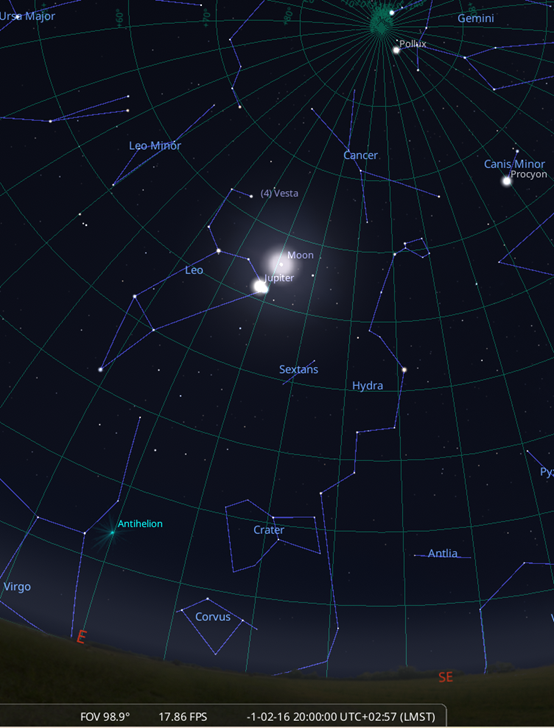
Star Map 1: The image above is a screenshot from Stellarium, a software simulating the starry sky. In the upper middle of the figure, the Jupiter-Regulus conjunction is in a clear evening sky at around 8 p.m. on February 16, 2 BC. The screenshot is taken from Baghdad as the observation point, capturing the celestial view to the east-southeast from the location. The second conjunction was similar to the one shown in the picture above.
During that time, the Babylonians named Regulus “Sharu,” meaning “king.” Meanwhile, in both Babylon and Rome during that time, Jupiter was considered the principal planet, so it was regarded as the greatest God and represented His kingship (Kihlman, 2018, p. 91; Larson, 2017a). In the Roman Empire, the greatest God could also be regarded as the emperor on earth at the same time. According to Larson (2017a), Jupiter, the planet representing the greatest God, met the star representing the king, Regulus, twice. Most likely, this refers to the fact that the greatest God has chosen a new King who would be born to represent Him in heaven and to enforce His kingly regime on earth (Kihlman, 2018, p. 91-92).
It is likely that at that time, the wise men from the east interpreted this event with the Old Testament. Regulus is the brightest star in the Leo constellation, and the following Old Testament passage mentions Judah as a lion. Thus, the magi connected this conjunction in Leo and the Star of Bethlehem to the Jewish people, especially the tribe of Judah (Larson, 2017b). In other words, those magi might have first observed the conjunction of Jupiter and Regulus and felt that the Supreme God had sent His King to be born in the land of Judah. Genesis 49:9-10 go:
9 Judah is a lion’s whelp; From the prey, my son, you have gone up. He couches, he lies down as a lion, And as a lion, who dares rouse him up? 10 The scepter shall not depart from Judah, Nor the ruler‘s staff from between his feet, Until Shiloh comes, And to him shall be the obedience of the peoples.
“Shiloh” in verse 10 means “tranquility” (BibleWorks 2013, 07886 Shiyloh) (The Bible materials in this article are all from BibleWorks software.) The words “scepter” and “ruler’s staff” in the same verse refer to the King’s utensils and are related to kingship. Some commentators refer to the above verses as being fulfilled in the later king David. However, for Christians, we have faith in the fulfillment of the scriptures in Jesus, for He is the King who reigns with the highest kingship and gives peace to every believer. In Genesis 49:10, “Nor the ruler’s staff from between his feet,” refers to the kingship of the new King, Jesus. For when He comes, some of the peoples, as representatives of all nations, would be converted and believe in Him. At the same time, Jesus was indeed from the tribe of Judah, one of the twelve tribes of Israel. It is predicted that the great King of the tribe of Israel and Judah, at Jesus’ birth, would be obeyed by the Gentiles. So, it is quite reasonable for those magi, if they were foreigners, to search for and worship the new King of the Jews.
The Babylonian astrologers interpreted the stars in the Leo constellation as the King who came from the tribe of Judah. And it is a way to understand the prophecies of the Old Testament from the perspective of a foreign nation. This understanding led them to succeed in finding the little child Jesus. And they were affirmed and praised by the author of the Gospel of Matthew.
3.2 The Venus-Jupiter conjunction on June 17, 2 BC
According to Carroll’s and Larson’s investigations, a few months later, on June 17, 2 BC, the Venus-Jupiter conjunction occurred. Viewed from Earth, the visual distance between the two planets was so close to each other, just as two planets became one very bright star (Carroll, 1997; Larson, 2017e). At that time, the conjunction of those two planets appeared extra bright in the night sky. The brighter golden Venus, which emitted a golden glow, overshadowed the whiter Jupiter. The conjunction of these two planets created a combination of light at night, with a golden sparkle in the center and a white halo surrounding it. The star map below shows the position of the Venus-Jupiter conjunction and the light emitted at night.
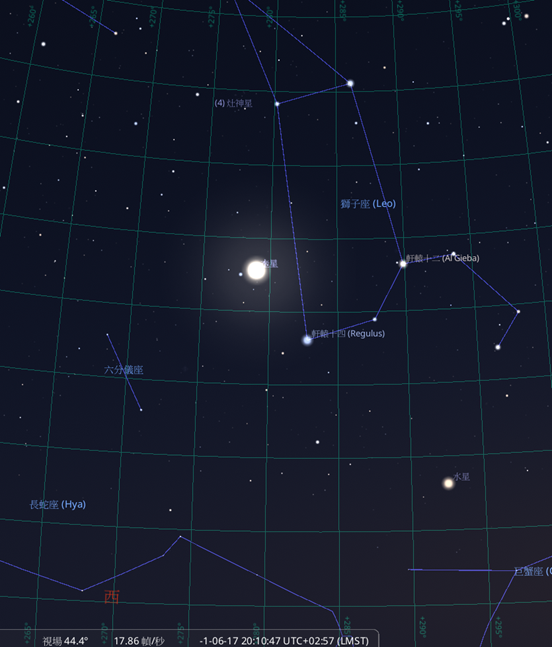
Star Map 2: The image above is a screenshot from Stellarium, a starry sky simulation software. In the upper middle of the figure showing a clear night sky, the Venus-Jupiter conjunction is seen at around 8 p.m. on June 17, 2 BC. To the lower right of the conjunction is Regulus in the Leo constellation. The screenshot is taken from Baghdad as the observation point, capturing the celestial view to the west-northwest from the location.
The Persians or Babylonians of the time believed that Venus represented fertility and reproduction (Kihlman, 2018, p. 27, 74). Venus-Jupiter conjunction, which might represent the greatest God to have a child and a new King to represent Him on earth. We believe that the God Most High indicated the appearance of the firstborn over all creation, i.e., God had begotten His only Son on earth (Hebrew 1:5). According to the Gospel of Matthew, this will only be revealed after Jesus’ resurrection, because He has been given all authority in heaven and on earth (Matthew 28:18). By the middle phase of the New Testament period, the Apostle Paul clearly points out: Jesus Christ is the God born from God (Colossians 1:15). Thus, the conjunction of Jupiter and Regulus alone might only mean that there was a newborn king among the Israelites. But in terms of the significance of Jupiter converging with Venus, the wise men from the east might have perceived this newborn Jewish King was likely to bless all nations on behalf of the greatest God. This might motivate those magi to travel the long road to worship Him so as to be blessed.
All the above meanings were fulfilled in Jesus. Jesus was born to represent the greatest God and become the greatest Emperor on earth. The God Most High has shown that He would incarnate into the world as a man on earth and will give abundance to all who believe in Him. His first coming made its spiritual meaning fulfilled. Then, at His second coming, His promises will all be substantially accomplished in all believers. In any case, the appearance of these astrological phenomena probably alerted some astronomers at that time. In short, the Star of Bethlehem symbolizes the newborn King and the emergence of God’s royal authority on earth.
In sum, separately on February 16 and May 9, 2 BC, Jupiter conjunct Regulus twice, together with the Venus-Jupiter conjunction on June 17 in the same year, those magi might feel that the new King had appeared in their west. They might have been familiar with the Old Testament prophecy and learned that Jupiter’s conjunction with Regulus might indicate the appearance of the newborn King of Judah. Moreover, they knew the information of Enuma Anu Enlil about the interpretations and meanings of the planets, and that the newborn King in Judaea, perhaps even the great King of the earth sent by the greatest God, would rule over their region and people. As a result, they would have to leave nearly half a year of work and travel long distances to find the little child Jesus, from Baghdad or eastern areas to worship Jesus with gifts as an offering. They arrived in the city of Jerusalem about mid-December of the same year. Some have speculated that the magi might have been Israelites in the diaspora in Baghdad or nearby, or foreigners from another nation, but were familiar with the Old Testament and Babylonian astrology. We suggest that they are more likely to be foreigners because they understood the Star of Bethlehem through a gentile perspective. In addition, sections 4.2 and 4.3 will further explain the possible meanings of the phenomenon of Venus-Jupiter conjunction in relation to Herod, etc., with reference to Enuma Anu Enlil.
4. Some astrological significance of the Star of Bethlehem and the worship of the wise men from the east
The following section will begin with an explanation of the biblical significance of the Star of Bethlehem according to Matthew 2, followed by a discussion of the information in Enuma Anu Enlil, including the possible meanings of the two kinds of conjunction. From these, we are going to explain the possible reasons why the wise men from the east worshipped Jesus, and compare those with the reasons why Herod tried to kill the little child new King in Bethlehem at that time.
4.1 The explanation of Astrology toward the Star of Bethlehem with reference to Matthew 2
Based on Matthew 2, Fredrick Larson proposed nine related characteristics of the Star of Bethlehem (Larson, 2017c). We believe that the following traits could conclude some of the previous discussion. First, the wise men from the east asked, “Where is He who has been born King of the Jews? For we saw His star in the east and have come to worship Him.” (Matthew 2:2) There are four characteristics here.
First, “King,” the Star is related to the royal authority of a new King.
Second, “born,” that is, the Star symbolizes the birth of the new King.
Third, “the Jews,” that the Star is related to the Jewish nation.
Fourth, “For we saw His star in the east” (Matthew 2:2b), which literally translates in the Greek as “saw His star rising from the east” (BibleWorks 2013, 395 anatole), meaning that the Star rose from the east, like the other stars. One Chinese translation omits the word “east” and states that “east” means “to rise” (Worldwide Bible Society, 2015, Chinese edition, pp. 9-10). We believe that the Star of the Jewish King referred to by the magi is mainly Jupiter, which had respective conjunctions with Regulus and Venus in previous times.
Then, Matthew 2:7 goes: “Then Herod secretly called the magi and determined from them the exact time the star appeared.” (Matthew 2:7) Here, two characteristics are implied.
Fifth, “the exact time the star appeared,” that is, the Star had a specific time to appear.
Sixth, from Herod’s response, it is obvious that he did not know exactly when the Star appeared previously.
The passage goes on to say that (Herod), “And he sent them to Bethlehem and said, ‘Go and search carefully for the Child; and when you have found Him, report to me, so that I too may come and worship Him.’ After hearing the king, they went their way; and the star, which they had seen in the east, went on before them until it came and stood over the place where the Child was.“ (Matthew 2:8-9) There are three characteristics here.
Seventh, the Star appeared for a considerable period, or at least not a short period, of time.
Eighth, the Star is ahead of the wise men when they were heading toward Bethlehem.
Ninth, the Star led them to the place where the child was, and then “stood over the place,” meaning that it “stopped. “
According to Matthew 2, Herod might not have noticed the appearance of these stars in the sky at that time, nor might he have understood their meaning without an explanation from the several wise men from the east. When the magi arrived in Jerusalem, they probably explained the meaning of the celestial stars and related the explanations from Enuma Anu Enlil. This prompted further action by Herod. These points will be revisited later.
It is worth noting that the specific Old Testament prophecy is mentioned in the discussion between the wise men from the east and Herod about the meaning of the stars (Matthew 2:6). Matthew seemed to have deliberately placed the prophecy at the center of the above passage throughout the astrological signs to highlight the birth of Jesus as the fulfillment of the prophetic message. But the astrological significance explained by the magi undoubtedly highlights the importance of the Old Testament prophecy. Thus, Matthew did not deny the guidance that the wise men received from astrology at that time. On the contrary, he confirmed the correctness and legitimacy of the direction they received from their research on astrology. When we examine the relevant passages in Matthew 2 and the Old Testament prophecy in Genesis, we will have a better understanding of the significance of Jesus’ birth at that time.
4.2 Possible interpretations of Enuma Anu Enlil concerning the Star of Bethlehem and related scriptures
In this section, we will further explain why the magi sought out the little child Jesus and worshipped Him. We also suggest a preliminary understanding of why Herod wanted to kill the newborn Jewish King. In Enuma Anu Enlil, there are some predictions about the phenomenon of Venus conjunct Jupiter in the west of Mesopotamia, as two planets come together and even overlap. The following is a summary.
- The reign of the king of the Amurru will bring forth destruction. Amurru, west of Babylon, was a name in Enuma Anu Enlil. It referred to present-day Israel, Lebanon, Jordan, and western Syria (Kihlman, 2018, pp. 93-94). The conjunction of Venus and Jupiter might lead the magi to believe that the destruction from the Amurru region, including Israel at that time, might impact the Mesopotamia region (Kihlman, 2018, p. 94).
- The king of Akkad (i.e., the emperor of Mesopotamia) would die, and the dynasty would be changed. The enemy would send a messenger or a soldier from the dynasty to the other side to seek peace (Kihlman, 2018, pp. 93, 113). Kihlman pointed out that the conjunction of Jupiter in retrograde motion with Regulus, and the phenomenon of Venus-Jupiter conjunction have the same meaning, i.e., the king of Akkad would die (Kihlman, 2018, p. 95).
At that time, Mesopotamia was occupied by the Parthian king in the east, who was regarded as an invader, likely indicating the Akkadian king in Enuma Anu Enlil. Thus, if the Akkadian king died due to the destruction of the king west of Babylon, the dynasty would have changed. This prediction is good news for them, because they can no longer be oppressed (Kihlman, 2018, p. 95). In fact, there was no significant king in the Amurru region except for Herod around 2 BC. In other words, Enuma Anu Enlil implied that the old Herod would bring destruction, including the massacre of little children in Bethlehem and its surroundings. The Parthian king at that time was Phraates IV (37-2 BC). If the magi from the east had seen the connection between these two phenomena in 2 BC, they might have concluded that a new King of the Jews would rise, unite His nation, and then overthrow the king east of Babylon. Indeed, Phraates IV died by poisoning in 2 BC, but the exact month of his death is not recorded in any document (Britannica Editors, n.d.). If this occurred around the time of the celestial conjunctions, the magi would have believed that the sign had been fulfilled, that the Parthian king had been overthrown. Thus, they needed to worship the new King so that their people might be saved from oppression and further destruction. This speculation might have inspired them to make a pilgrimage to worship the newborn King in Judaea. So, the magi were the first to go to Jerusalem, because they probably thought that Herod would have a greater chance of knowing what the astrological prophecy and the succession of kings explained in Enuma Anu Enlil meant, and thus knowing where the newborn King was. We believe that there might have been some people in the Roman Empire who understood the meaning of the conjunctions of different astronomical stars. Yet only a few wise men from the east of Jerusalem were willing to pay the price to worship the newborn King of Judaea and offer Him gifts. These should be the reasons behind their actions.
Enuma Anu Enlil indicated that soldiers would be sent to the enemy. However, at that time, Mesopotamia had no indigenous king and thus no corresponding soldiers could be sent out. This would likely trigger the magi from the east to set out to Israel to worship the new King (Kihlman, 2018, p. 95). In this sense, the gifts offered to Jesus by those magi, gold, frankincense, and myrrh, were gifts to seek long-lasting peace from the new King to avoid future war and destruction with the new King in the future. Their costly worship, after travelling a long way, is on behalf of themselves, and possibly on behalf of their own people, as a sign of willing submission and surrender to Jesus, the new Great King, and signifies their acceptance of His sovereignty and governance. If this is correct, it is likely that the wise men were familiar with Israeli history and sought peace.
If the above is correct, the description in Matthew 2 echoes the several names of the foreign women recorded in Matthew 1 of Jesus’ genealogy, i.e., Jesus is the King of the Jews and King of Gentiles. The obedience of the few Gentiles to the God of Israel, though small in number, is in accordance with the prophecy about the peoples obeying the Jewish King mentioned in Genesis 49.
As can be seen from Matthew 2, the chief priests and teachers of the law of Jerusalem pointed out that the newborn King should have been born in the town of Bethlehem,
“And you, Bethlehem, land of Judah, are by no means least among the leaders of Judah; For out of you shall come forth a Ruler who will shepherd my people Israel.” (Matthew 2:6)
At that time, if Herod had carefully read the above verse, he would have known that a new king would replace him and his heirs as the new King of Israel in a new dynasty. Actually, this verse is a quote from the Old Testament book of Micah.
“But as for you, Bethlehem Ephrathah, Too little to be among the clans of Judah, From you One will go forth for Me to be ruler in Israel. His goings forth are from long ago, From the days of eternity.” (Micah 5:2)
This verse focuses on the new King who would come from Bethlehem, who is from eternity and even divine. This can be understood as confirming the legitimate and significant meaning of the conjunction of Jupiter and Regulus, and that the God Most High would send His new King into the world. We believe that Matthew deliberately omitted the eternal characteristics of the newborn King and did not want to apply the meaning of the astrological conjunction in Enuma Anu Enlil to explain Jesus’ three- year earthly mission in Israel. He did not want to confuse his readers with Jesus’ deity with his earthly ministry.
At that time, Herod and the inhabitants of Jerusalem might have been disturbed by the above explanation, for the explanations from foreign astrologers and the high priests and scribes pointed out that the sudden arrival of the King from Bethlehem might have restored David’s dynasty and would soon overthrow the throne of Herod in the capital of Jerusalem. It is worth noting that some of the explanations in the following passages in Micah are quite consistent with the interpretations of Enuma Anu Enlil.
5 This One will be our peace. When the Assyrian invades our land, When he tramples on our citadels, Then we will raise against him Seven shepherds and eight leaders of men. 6 They will shepherd the land of Assyria with the sword, The land of Nimrod at its entrances; And He will deliver us from the Assyrian When he attacks our land And when he tramples our territory. (Micah 5:5-6)
The above scriptures speak of the newborn King who would be the peace of Israel (Micah 5:5). This seems to echo the earlier reference to the king as “Shiloh,” the tranquility (Genesis 49:10). Meanwhile, the Assyrian Empire in the scriptures was very close to the Amurru region mentioned above in terms of its territory. In fact, Herod‘s father was an Edomaean who was a descendant of the Edomites (Wiebe, 2023; Pao & Luc, co-eds., 2008, p. 1865, Chinese edition only). So, it’s not surprising that he would think he was the target that would be attacked, as the scriptures indicate. For if the Assyrian invader in the scriptures was understood as an empire rather than a nation, Herod would feel that he and his family were the invaders prophesied above, and that they would be overthrown soon. In fact, many feudal kings in history often used the local people’s offerings to live in luxury, and it was difficult for them not to oppress the local people. Therefore, Herod wanted to kill all the little children of Bethlehem to secure his throne, and the slaughter is understandable. This is possibly the first reason for Herod to intend to kill the newborn Jewish King.
As mentioned in the previous passages, the Assyrians would be dethroned after the new Israeli King gained power, and the new King would deliver the Jews from foreign oppression. However, the subsequent appearance of Jesus proved to be less likely to fulfill the prophecy of Micah. But based on Enuma Anu Enlil and the prophecy in Micah, it was easy to speculate that Jesus was the newborn Jewish King who was going to resist the oppression of foreigners on the Israelites at that time. Even if the interpretations of Enuma Anu Enlil or the book of Micah regarding Jesus’ ministry were not accurate in time, this does not distract the worship of Jesus by those magi in any way. As a result, they took guidance from the Old Testament scriptures in Jerusalem and then traveled to the town of Bethlehem.
4.3 Herod and the wise men reacted differently due to the interpretations of the stars
Kihlman studied Enuma Anu Enlil and came up with the following predictions regarding the effects of astrological phenomena on human societies. The tablets describe the meaning of Jupiter’s retrograde motion around Regulus as follows:
“If Jupiter had passed Regulus and then moved in retrograde out of the breast of Leo, … (and) stays within its setting,” (referring to Star Map 1, this means Jupiter moves toward the Moon in the Map, and stays still below it), then “someone will rise, kill the king and seize the throne.”
This was the only bad sign about Jupiter’s retrograde (Kihlman, 2018, p. 92). This might be one of the reasons for the unrest of Herod and the entire city of Jerusalem (Matthew 2:3), especially because he was afraid that some Israelites would assassinate him for welcoming the birth of the new Israeli King. So, Herod ordered to kill all little children in Bethlehem out of fear (Matthew 2:16). This is possibly the second reason for Herod to intend to kill the newborn Jewish King. Those magi might have foretold the astronomical phenomenon of Jupiter’s retrograde and halting, and the relevant meanings to Herod at that time.
Jupiter appeared at a specific time on most days from June to December 2 BC, such as in the evening or early morning. This is consistent with the fifth and seventh features in the above descriptions concerning the Star of Bethlehem in Matthew 2. According to Larson’s account, in mid-to-late December 2 BC, the magi set out from Jerusalem and headed south to Bethlehem, with Jupiter indeed ahead of them. And Jupiter stopped above the town of Bethlehem (Larson, 2017d; Larson, 2017e). Meanwhile, Kihlman believes that they most likely got up early in the morning and walked, because at that time Jupiter, in a clear sky, was still clearly visible, and was south of Jerusalem, pointing toward Bethlehem (Kihlman, 2018, p. 97). Larson’s (2017d) research indicated that on December 25, Jupiter entered a state of complete stillness due to retrograde motion. Thus, the record in Matthew 2:9 recorded that the star “stood over” Bethlehem (Larson, 2017d). However, using a different starry sky simulation software, we found that the halt of Jupiter occurred a few days before Christmas. In other words, it is likely that the magi found Jesus on the 25th or some days before and worshipped Him. This might explain why they “rejoiced exceedingly” when they saw the star resting over in the place where the little child was (Matthew 2:9-10) (Kihlman, 2018, p. 97, 99). Thus, this is consistent with the eighth and ninth features of the Star in Matthew 2 mentioned above. According to the relevant scriptures, the magi rejoiced greatly at the clear guidance of the Star for worshipping Jesus. This is a big contrast to the fear of Herod with his action of slaughtering little children. (We believe that if Larson’s investigation is correct, Christmas is celebrated in many places on December 25 every year and happens on the same day as the worship of Jesus by the magi from the east. These can be understood as a miraculous coincidence.)
When the several wise men from the east arrived in Bethlehem, Jupiter might have been on top of a certain house. Then they went in and worshipped the little child Jesus (Kihlman, 2018, p. 95).
After coming into the house they saw the Child with Mary His mother; and they fell to the ground and worshiped Him. Then, opening their treasures, they presented to Him gifts of gold, frankincense, and myrrh. (Matthew 2:11)
Notice that Jesus is mentioned in the above scripture as the “Child” (paidion in the Greek) rather than as a “baby” or a “nursing infant” (Matthew 21:16, nepios or thelazo respectively). They then entered the house, not the manger. At that time, Jesus was not a newborn baby. Thus, His age might have been more than one year old. If this understanding is correct, Jesus might have been born early, probably in the summer of 3 BC. This corresponds with the calculation of Jesus’ death in April, AD 30, when He was around thirty-three years old, as mentioned earlier in this essay. We speculate that Jesus was born in the summer also because shepherds were guarding the sheep in the field right after His birth (Luke 2:8). In fact, Israel’s climate can be quite cold, with sometimes frost or snowfall at night during winter, making it difficult to sleep in the open field. So, Jesus was probably born in the summer.
In addition, according to Enuma Anu Enlil, there was a sign that describes Jupiter’s steadiness. “If Jupiter becomes steady in the morning, enemy kings will be reconciled,” and the word “reconciled” can also be translated as “made peace.” (Kihlman, 2018, p. 99). Those wise men did not represent any kings, and neither the Parthian king nor Herod reconciled with the newborn Jewish King during that time. Therefore, we believe that if this part has a meaning, it can be understood from a spiritual perspective. Apart from spiritual interpretation, there seems to be no reasonable explanation for the sign in the tablets that Jupiter “stopped” at that time.
Around December 25 or a few days earlier, 2 BC, the wise men of the east saw a steady and unmoving Jupiter in the early morning. This means that according to a biblical interpretation, the enemy kings may imply the group of the devil or Satan, would be “involuntarily reconciled,” i.e., they would have to be forced to submit under the authority of Jesus. (In the bible, devil means the slanderer, while Satan means the opponent of God.) Satan certainly has no right to be the enemy of God by any means. However, he has held many sinners of his hostage over many years, and has become the enemy of God, which might be understood as the enemy kings referred to in Enuma Anu Enlil. In any case, after the birth of Jesus, Satan and his subordinates could no longer use those who trust in God to initiate any effective rebellions against Him. Jesus, as a human being, will surely lead all who believe in Him to subdue Satan and evil spirits once and for all. Indeed, evil spirits are not willing to acknowledge that Jesus came into the world in the flesh (1 John 4:2-3). It is because the birth of Jesus was the beginning of their downfall. Still, Satan and his subordinates are not willing to be “involuntarily reconciled,” and they are still going to attack Jesus’ disciples illicitly.
Probably, the downfall of the Akkad king mentioned in Enuma Anu Enlil could refer to the demise of Herod. During the magi’s visit to Jerusalem, they reported to Herod everything they had seen and their relevant explanations, possibly including some of the above predictions. As a result, Herod ordered the killing of all children under the age of two in and around Bethlehem (Matthew 2:16) to ensure the continuation of his dynasty. It seems possible that Jesus was around one and a half years old at that time. Joseph, the father of Jesus, after receiving an instruction from an angel in a dream, left Bethlehem before the massacre happened altogether with his family (Matthew 2:13). In fact, Herod’s order to kill had no substantial effect on Jesus. Later verses show that the wish of old Herod was to some extent fulfilled. In fact, junior Herod, one of the old Herod’s sons, succeeded his father as king later (Matthew 2:22), but he ruled over a smaller territory than his father. Finally, according to the New Testament record, Herod, the son of old Herod, killed James, who was one of the twelve apostles, and then his life was cut tragically short due to an event of dishonoring the God of Israel (Acts 12:2, 23).
To summarize this section, the February 16 and May 9, 2 BC, conjunction of Jupiter and Regulus indicated that the greatest God would send His great King as His representative on earth, and this related to the tribe of Judah. On June 17 of the same year, the Venus-Jupiter conjunction occurred, and the perceived distance of the two planets near Bagdad is so close that the two stars become one very bright star. Several wise men from that place or nearby, who learned that the star in the constellation Leo might be related to the newborn King of the Jews, set out for Jerusalem to find and worship the new great King. Meanwhile, they learned that the retrograde motion on Jupiter might indicate that the life of Herod and his dynasty would be in danger. In late December of the same year, when those magi east set out from Jerusalem and headed south to Bethlehem, Jupiter did lead them ahead to the town. By the 25th or a few days earlier, the movement of Jupiter had entered a state of stillness. Matthew indicates that the star was resting on a certain house in Bethlehem. Then, they went in and worshipped the little child Jesus with gifts. It might be the account of how the magi saw the stars in the sky and then searched for and worshipped the little child Jesus. It is likely that they combined the astrology of the Old Testament with the knowledge of Enuma Anu Enlil, the ancient Babylonian astrological clay tablets, to understand that the birth of Jesus would replace king Herod. And what they had found was indeed the new King of the Jews, the One who represents the God Most High.
According to the Bible, Jesus’ death sentence statement on His crucifixion is “the King of the Jews“ (Matthew 27:37). This charge was confirmed by Pilate, the Roman governor during the time (Matthew 27:11). In other words, the birth and death of Jesus, according to Matthew’s account, might have been confirmed by two groups of gentiles that He is the King of the Jews (Matthew 2:2). When Jesus was on earth, He personally confirmed His mission was mainly to save the Israelites (Matthew 15:24). Unfortunately, the Israelites during that time rarely recognized him as the Great King chosen by the God Most High. After Jesus’ resurrection, He declared that He receives all authority from God the Father in heaven and on earth and then sends His disciples to disciple all nations (Matthew 28:19-20). Finally, in the last Book of the Bible, the Revelation, it is revealed that Jesus is the King of kings and Lord of lords (Revelation 17:14, 19:16). This echoes some ancient Babylonians’ belief that Jupiter could indicate the epiphany of the greatest God. And Jesus is indeed the greatest God who appeared in the world in human form.
It is worth mentioning that the wise men from the east might have searched for Jesus based on Enuma Anu Enlil and the astrological signs they observed during that time. Instead of divination or worshipping the heavenly signs, they saw them as a tool to seek and confirm God’s work. Thus, they are definitely not the witches, soothsayers, etc., condemned in the Old Testament. We believe that it is right and wise to understand God’s work through His creation and even to seek reliable signs to worship Jesus. Believers should be careful not to turn God’s creation into idols to be worshipped. Meanwhile, we should not ignore or dismiss the message that God has conveyed through His created world for us, even though sinners often distort or misunderstand His creation in various ways. Rather, believers need to know and worship God by understanding the messages He wants to render to us through His creation in the world.
5. Several other theories about the Star of Bethlehem
There are many explanations about the Star of Bethlehem, and here is just a review of a few recent proposals or theories.
5.1 Astronomical and celestial phenomena from 7 to 6 BC
Some people claim that the appearance of the Star of Bethlehem is related to the movement of the planets. For instance, in 7 BC, Saturn was conjunct Jupiter three times. On February 6 BC, a conjunction of Jupiter, Saturn, and Mars occurred, and the close grouping of the planets in 7 and 6 BC might be understood as the star of Bethlehem (Strobel, 2011). Besides, Michael Molnar proposed that in 6 BC, in the Aries constellation, Jupiter was obscured by the Moon twice (Jones, 2017). Or even the light of the moon at that time might have been mistaken for the Star of Bethlehem. However, since the phenomena did not occur between 4 and 1 BC, these claims or explanations will not be further discussed in this article.
5.2 The Star of Bethlehem might be a supernova.
Some scholars believe that the Star of Bethlehem is a series of astronomical events, including a conjunction of planets that appeared in 8 and 7 BC, or two supernovae that erupted in 5 and 4 BC, respectively. Supernovae in 4 BC have been recorded in China and other eastern regions too (Tipler, 2005; Morehouse, 1978). However, these theories span four years, quite a long time. As mentioned earlier, 8 or 7 BC did not fit the date of Jesus’ birth. Furthermore, regarding the appearance of supernovae, if its brightness was obvious enough, it was quite impossible for Herod at that time to be unaware of the appearance of supernovae. This echoes the fourth, fifth, and sixth characteristics of the Star of Bethlehem mentioned earlier in the discussion of Matthew 2, including the unlikeness of a supernova abruptly “stopped” in a certain position and paused its movements. According to the scriptures, the star of Bethlehem appeared for a considerable period of time, and so it is unlikely that it was a supernova explosion. Therefore, the above claims will not be further discussed in this article.
5.3 The Star of Bethlehem is a comet.
This proposal is made by Colin Nicholl (2015). However, a comet was considered a bad sign at that time, a symbol of doom and destruction (Kihlman, 2018, p. 88). Comets that can be understood as meteorites hitting the ground are always destructive. Therefore, this seems to be the opposite of the meaning of the good news brought forth by the Star of Bethlehem. Meanwhile, the appearance of a great comet is often obvious, and it is unlikely that Herod was unaware of the appearance of the comet. This theory might also contradict the fourth, fifth, and sixth features of the above description of the Star of Bethlehem in Matthew 2. Finally, Nicholl mentioned that the comet appeared in 6 BC, not between 4 and 1 BC. As a result, we will not further discuss his proposal in this article. We believe that the Star of Bethlehem is unlikely to be a comet because the argument is weak.
6. Conclusion
In summary, we find that there are three main theories in the astronomical community explaining the Star of Bethlehem, which are planetary conjunctions, a comet, or a supernova. This article focuses on the astronomical signs from 4 to 1 BC and the star of Bethlehem as described in Matthew 2. Besides, we get other information and opinions, including ambivalent ones (e.g., Crudele, 2002), but we discard them all here.
At the beginning of this essay, we explain the astrology of the Bible and the astrology of ancient Babylon, so that we can have a possible understanding of how the magi from the east could find the little child Jesus. We have depicted the actual movement of the stars and have suggested what the Star of Bethlehem is. We conclude that the Star of Bethlehem might have been Jupiter, including the conjunct planets during that time. And the appearance of the stars began with the double conjunction of Jupiter and Regulus in February and May 2 BC, indicating that the God Most High sent His Great King to the earth. This was followed by the same year in June, when Venus near Leo joins Jupiter. The short “stop moving” of the Star of Bethlehem, i.e., Jupiter above the town, was caused by a retrograde motion near December 25, 2 BC (Kihlman, 2018, pp. 97-98). In other words, the magi recorded in the Gospel of Matthew might have spent six months or more on their journey to Jerusalem and then to Bethlehem as they followed the Star of Bethlehem, which represented the newborn King of Israel. In fact, their visit had been a mystery for centuries. However, with the development of astronomical technology, people nowadays can find relevant information in starry sky simulation software, such as Stellarium (http://www.stellarium.org/). Hopefully, many problems related to astronomy in the past can be resolved soon.
In our understanding, some Bible verses require relevant external sources to perfect their expositions, including the worship of the little child Jesus by the wise men from the east, which is discussed in this essay. In interpreting the Star of Bethlehem, we have used reasonable, useful, and relevant sources of ancient Babylonian astrology, since they were likely to have been known to the magi. This knowledge makes the appearance and interpretation of the astrological signs more plausible. External data related to the Bible may not fully reflect the completeness of God’s truth, but they have certain referential value when explaining some events or phenomena. This is because some of the things or words recorded in the Bible might be related to its surrounding peoples and cultures. While the wise men might have been skewed in their understanding of Jesus as the King of the Jews, the writer of Matthew’s Gospel praised their act of worshipping Jesus with gifts offering. So, we need to be open to all kinds of knowledge that do not conflict with the Bible, if they can help us to worship Jesus, the King of kings. And we believe this is what the biblical writers approve, too.
-End-
Reference
BGEA Staff. 2004. “Is it All Right for a Christian to Believe in Astrology and Discover God’s Plan for His or Her Life through a Horoscope?” By Billy Graham Evangelistic Association. Retrieved December 14, 2023, from https://billygraham.org/answer/is-it-all-right-for-a-christian-to-believe-in-astrology-and-discover-gods-plan-for-his-or-her-life-through-a-horoscope/
BibleWorks. 2013. 9.0 version. (With updated information.) Norfolk, VA: BibleWorks, LLC.
Bond, H. 2013. “Dating the Death of Jesus: Memory and the Religious Imagination.” New Testament Studies, 59(4), 461-475. Retrieved March 18, 2023, from https://doi.org/10.1017/S0028688513000131
Britanica Editors. n.d. “Phraates IV.” Encyclopædia Britannica. Retrieved December 15, 2025, from https://www.britannica.com/biography/Phraates-IV
Carroll, S. S. 1997. The Star of Bethlehem: An Astronomical and Historical Perspective. Pulcherrima Productions. Retrieved March 28, 2023, from https://www.tccsa.tc/articles/star_susan_carroll.pdf
Clifton, Jimmy. 2024. The Bright and Morning Star. (A Christian song.) Retrieved December 25, 2024, from https://www.youtube.com/watch?v=VN63KHCCd2k
Crudele, Michele. 2002. “Star of Bethlehem.” In G. Tanzella-Nitti, I. Colagé & A. Strumia (co-eds.). Interdisciplinary Encyclopedia of Religion and Science. Retrieved February 2, 2025, from https://inters.org/star-of-bethlehem
Elwell, Walter A. & Robert W. Yarbrough. 2005. Encountering the New Testament: A Historical and Theological Survey. (Chinese edition by Hong Kong: Chinese Bible International Limited, 2006.)
Hyatt, Chad. 2005. Bright and Morning Star. (A Christian song.) Retrieved December 25, 2024, from https://www.youtube.com/watch?v=4BN2zxM2-8I
Jachowski, R. J. 2015. “The Death of Herod the Great and the Latin Josephus: Re-Examining the Twenty-Second Year of Tiberius.” Journal of Greco-Roman Christianity and Judaism, 11, pp. 9-18. Retrieved March 28, 2023, from https://www.academia.edu/19833193/The_Death_of_Herod_the_Great_and_the_Latin_Josephus_Re_Examining_the_Twenty_Second_Year_of_Tiberius
Jones, Meg. 2017. “The Astronomy Behind The Fabled Star Of Bethlehem.” Retrieved December 27, 2025, from https://wisconsinlife.org/story/the-astronomy-behind-the-fabled-star-of-bethlehem/
Kennedy, D. James. 1993. The Real Meaning of the Zodiac. Fort Lauderdale, FL: TCRM Publishing.
Kihlman, D. 2018. Star of Bethlehem and Babylonian Astrology: Astronomy and Revelation 12 Reveal What the Magi Saw. Trollhattan, Sweden: Dag Kihlman Publish.
Larson, F. 2017a. “A Coronation.” The Star of Bethlehem. Retrieved March 28, 2023, from https://bethlehemstar.com/starry-dance/coronation/
Larson, F. 2017b. “The Birth of a King.” The Star of Bethlehem. Retrieved March 28, 2023, from https://bethlehemstar.com/starry-dance/the-birth-of-a-king/
Larson, F. 2017c. “The Nine Points of Christ’s Star.” The Star of Bethlehem. Retrieved March 22, 2023, from https://bethlehemstar.com/setting-the-stage/the-nine-points-of-christs-star/
Larson, F. 2017d. “To Stop a Star.” The Star of Bethlehem. Retrieved March 29, 2023, from https://bethlehemstar.com/starry-dance/to-stop-a-star/
Larson, F. 2017e. “Westward Leading.” The Star of Bethlehem. Retrieved March 29, 2023, from https://bethlehemstar.com/starry-dance/westward-leading/
Morehouse, A. J. 1978. “The Christmas Star as a Supernova in Aquila.” Journal of the Royal Astronomical Society of Canada, 72(2). Retrieved March 28, 2023, from https://articles.adsabs.harvard.edu/cgi-bin/nph-iarticle_query?db_key=AST&bibcode=1978JRASC..72…65M&letter=0&classic=YES&defaultprint=YES&whole_paper=YES&page=65&epage=65&send=Send+PDF&filetype=.pdf
New American Standard Bible, The. (NASB) 1995. La Habra, CA: The Lockman Foundation.
New Revised Standard Version Bible. 1989. Division of Christian Education of the National Councils of the Churches of Christ in the United States of America.
Nicholl, Colin. 2015. The Great Christ Comet: Revealing the True Star of Bethlehem. Wheaton, Ill.: Crossway Books.
Nicolai, Philipp. 1599. O Morning Star! How Fair and Bright. (A Christian song.) Trans. by Catherine Winkworth, original in Spanish. Retrieved December 25, 2024, from https://hymnary.org/text/o_morning_star_how_fair_and_bright_thou
Pao, John & Alex Luc (co-eds.). 2008. The Christian Renewal Ministries Study Bible. Milltown, NJ: Christian Renewal Ministries, Inc. (Chinese edition only)
Pickering, M. 1986. “Matthew.” In F. F. Bruce & H. L. Ellison (co-eds.). The International Bible Commentary with the New International Version, pp. 1121-1155.
Schweitzer, Albert. 1905, 2005. The Quest of the Historical Jesus. New York: Dover Publications. (The original book title as Geschichte der Leben-Jesu-Forschung.)
Steinmann, A. 2009. “When did Herod the Great Reign?” Novum Testamentum, 51(1), pp. 1-29. Retrieved March 28, 2023, from https://doi.org/10.1163/156853608×245953
Strobel, N. 2011. “The Star of Bethlehem: An Astronomical Perspective.” Retrieved December 28, 2025, from https://www.astronomynotes.com/history/bethlehem-star.html
Tipler, F. J. 2005. “The Star of Bethlehem: A Type Ia/Ic Supernova in the Andromeda Galaxy.” Retrieved March 28, 2023, from https://www.academia.edu/8307178/The_Star_of_Bethlehem_a_Type_Ia_Ic_Supernova_in_the_Andromeda_Galaxy
Tong, S. S. 2023a. Chapter Two: The Celestial Dome – The Motion of Celestial Bodies as Seen from Earth (Lecture Notes, Chinese edition only). The Chinese University of Hong Kong Department of Physics.
Tong, S. S. 2023b. Chapter Five: Celestial Phenomena and Their Interpretation of Good and Bad Fortune—The Essence of Chinese Astronomy (Lecture Notes, Chinese edition only). The Chinese University of Hong Kong Department of Physics.
Wiebe, Dianna. 2023. “Who was Herod the Great?” Retrieved December 23, 2024, from https://www.grapevinestudies.com/blog/who-was-herod-the-great/
Worldwide Bible Society, The. 2015. The Holy Bible: New Testament—Worldwide Chinese Bible. Hong Kong: The Worldwide Bible Society Limited.